



Brassica oleracea var. gongylodes
Kohlrabi, Red - microgreens seeds
✨
- Regular price
-
€8,95 - Regular price
-
- Sale price
-
€8,95
Couldn't load pickup availability
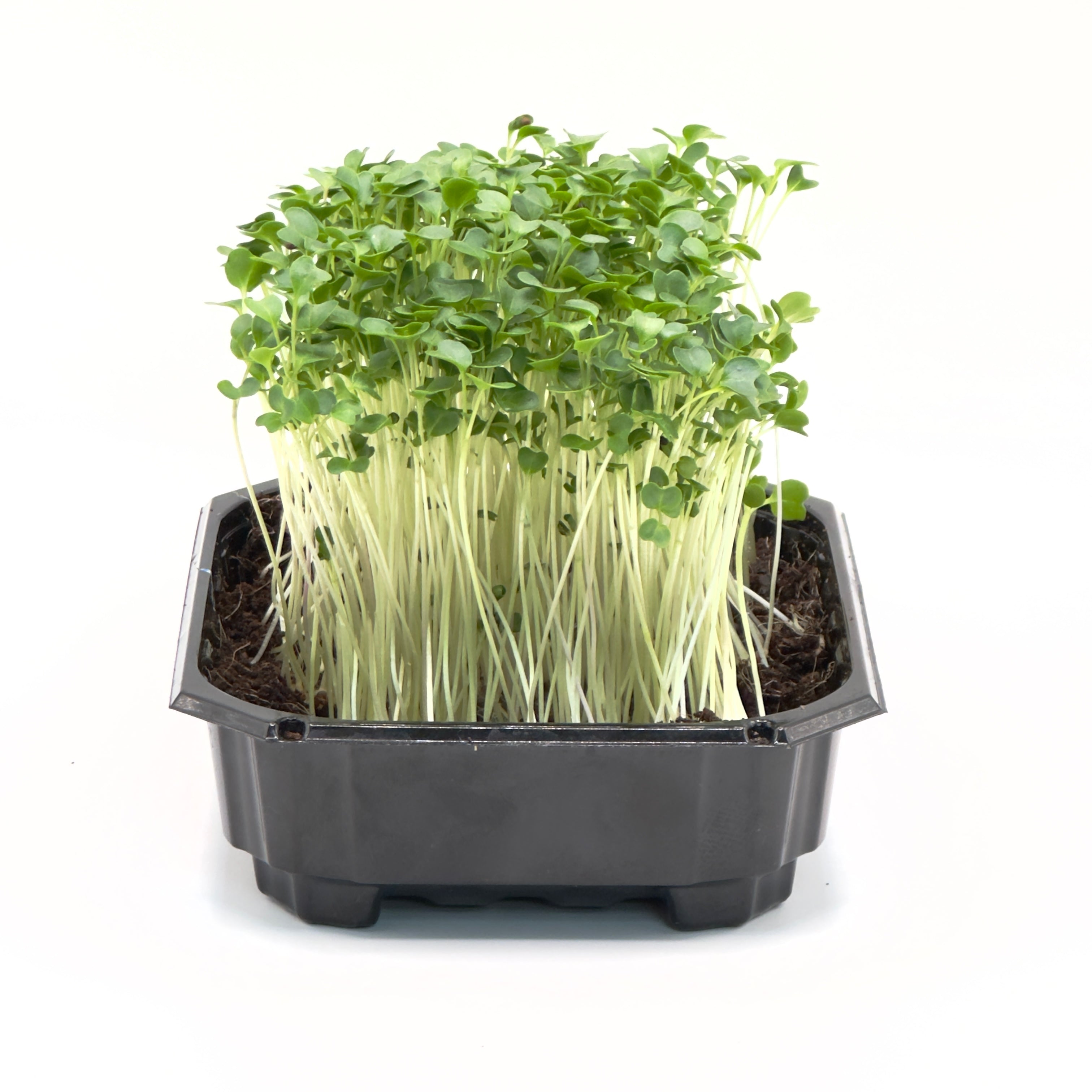
Vivid violet stems, a juicy crunch, and ready to harvest in under two weeks — Red Kohlrabi is the easiest showstopper in your microgreens line-up.
 Beginner-friendly brassica that germinates reliably and produces strikingly uniform, upright stands with very little fuss.
 No soaking needed — sow directly onto moist substrate and expect sprouts within 4–5 days, harvest-ready in 10–12 days.
 Rich in vitamins C, K and B6, plus potassium and calcium; contains glucosinolates that convert to health-promoting isothiocyanates.
 Mild, slightly sweet cabbage flavour with a satisfying juicy crunch — perfect raw on salads, grain bowls, sandwiches, and as a vivid finishing garnish.
100% satisfaction guarantee
Your satisfaction is our top priority.
If something's not right, we’ll make it right — whether that means replacing your item or giving you a full refund. No fuss, no hassle.
SHIPPING INFORMATION
Shipping cost is based on weight and destination. Just add products to your cart and use the Shipping Calculator to see the shipping price.


Details
Vivid violet stems, a juicy crunch, and ready to harvest in under two weeks — Red Kohlrabi is the easiest showstopper in your microgreens line-up.
Beginner-friendly brassica that germinates reliably and produces strikingly uniform, upright stands with very little fuss.
No soaking needed — sow directly onto moist substrate and expect sprouts within 4–5 days, harvest-ready in 10–12 days.
Rich in vitamins C, K and B6, plus potassium and calcium; contains glucosinolates that convert to health-promoting isothiocyanates.
Mild, slightly sweet cabbage flavour with a satisfying juicy crunch — perfect raw on salads, grain bowls, sandwiches, and as a vivid finishing garnish.
FULL SPECIFICATION TABLE
General Specification
| Common Name | Red Kohlrabi microgreens |
| Botanical Name | Brassica oleracea var. gongylodes |
| Seed Type | Conventional, untreated, non-GMO |
| Stem/Leaf Color | Purple-violet stems; green cotyledons with violet blush |
| Flavor & Texture | Mild, slightly sweet cabbage-like flavour; juicy, crunchy stems |
| Seed Count per 10g | ~2,500 seeds (≈250 seeds/gram) |
Cultivation Data
| Difficulty | Very easy — uniform stands, high germination rate |
| Preferred Medium | Soil or coco coir; soil-based mix recommended for best colour development |
| Seeding Density (1020 tray) | 9.5 g per 1020 tray (25×50 cm) |
| Seeding Density (10x10 cm) | 0.76 g per 10×10 cm |
| Expected Yield | ≈8–12× seed weight |
| Soaking | No soaking required — sow dry directly onto moist medium |
| Blackout Days | 3–4 days under weight (0.5–1 kg) for uniform germination |
| Watering, pH & Temp | Bottom-water only; keep medium evenly moist. Target pH 5.8–6.2. Temperature 18–22 °C. Ensure good airflow after blackout. |
| Sprouting Time | 4–5 days |
| Harvest Time | 10–12 days (cotyledon stage); up to 16 days for first true-leaf stage |
Health & Nutrition
| Vitamins | Vitamin C (ascorbic acid), Vitamin K (phylloquinone), Vitamin B6 |
| Minerals | Potassium, calcium, phosphorus; also iron and magnesium present |
| Notable Compounds | Glucosinolates (incl. glucoraphanin) → hydrolysed to isothiocyanates (e.g.8;color:#374151;margin:10px 0 20px">Red Kohlrabi microgreens are one of the most visually arresting varieties you can grow: deep violet-purple stems shoot upward beneath broad green cotyledons flushed with the same violet blush, turning any plate into a small piece of art. The flavour is gentle and approachable — a clean, milky sweetness with the faintest cabbage note and a satisfying snap when you bite through the juicy stems. Lay a handful over a roasted beetroot and goat's cheese salad, fold into cold rice paper rolls, or pile onto an open-faced sandwich for instant colour and texture. Red Kohlrabi is also one of the most forgiving crops in the microgreens world: it germinates fast, stands up straight, and rarely disappoints — making it an ideal first grow or a reliable weekly staple. GROWING INSTRUCTIONS 1 Prepare your tray and medium: Fill a tray with holes with about 2–3 cm of good-quality potting mix or coco coir, level it gently and water from below or mist thoroughly until evenly moist but not waterlogged — squeeze a handful; it should hold together without dripping. This is your seedbed, so take a moment to make it level and consistent. 2 Sow the seeds: Scatter approximately 9.5 g of seeds evenly across a 25×50 cm tray (about 0.76 g per 10×10 cm section). Red Kohlrabi seeds are small, hard, and round — use a shaker bottle or cup and sow in overlapping circles to avoid bare patches. Give the tray a gentle shake to settle seeds, then press them lightly into the medium with a flat board or spare tray for good soil contact. 3 Cover and weight for blackout: Stack an empty tray on top (with a small weight of 0.5–1 kg) to apply gentle, even pressure — this dramatically improves germination uniformity and produces strong, straight stems. Keep in a dark spot at 18–22 °C. Check once daily: you should start to see pale sprouts pushing up within 2–3 days, and by day 4 the dome of seedlings will be lifting the cover — an exciting moment! 4 Move to light: After 3–4 days of blackout, remove the cover and place the tray under a grow light positioned about 25–30 cm above the canopy, or in a bright spot with indirect natural light. Almost immediately you will watch the stems begin to deepen in colour — pale cream transitions to that distinctive violet-purple as anthocyanins develop. Ensure good airflow around the tray to keep the micro-climate fresh. 5 Water carefully: From this point on, water exclusively from below by pouring into the outer tray without holes — this keeps the foliage dry, dramatically reducing the risk of mould. Check daily; the medium should feel consistently moist. Maintain pH 5.8–6.2 if you are monitoring your water, and keep ambient temperature at 18–22 °C. 6 Watch them grow: Over the next 5–8 days your tray will fill with a dense, upright canopy of green-and-violet leaves reaching 5–9 cm tall. You will notice a faint fresh-vegetable scent as the tray fills in — that is the glucosinolates doing their thing. If any stems look pale or leggy, move them closer to your light source. 7 Harvest: When the cotyledons are fully open and the stems show their best violet colour — typically days 10–12 — harvest with clean scissors just above the soil line. Taste one stem first and enjoy that juicy, sweet crunch. Do not rinse until just before serving; pat or spin dry, then store loosely in an airtight container in the fridge for up to 5 days.
|
Why Choose Deliseeds?
-
Untreated & Non-GMO, Conventional or Organic Safe, high-germination seeds. We also offer wide selection of certified organic seeds.
-
Fast EU Shipping
Orders dispatched within 24h. Delivery times 1-5 working days.
-
100% Satisfaction Guarantee
If you're not satisfied - you'll get a replacement or a refund.
-
Expert Support
We mean it! You get our personnal support to help you succeed.